
HOME / CAPABILITIES / CUSTOM BRACKETS
CAPABILITY 02 / 04 · CUSTOM FROM DRAWING
Exactly as drawn. Every single time.
The bracket you need doesn't exist yet. Send a CAD file, a PDF, or a sketch with dimensions we'll quote it, review it for manufacturability, prove it with a first article you approve, and then make it the same way for as long as you need it.
UNIQUE DESIGNS
15,000+
MINIMUM ORDER
100 pcs
TOOLING, ONE-TIME
$1,055+
MINIMUM ORDER
100 pcs
Proto to production
TOOLING
$1,055-1,755
One-time, on file
LEAD TIME
5-6 weeks
From approved PO
MATERIALS
Steel · SS · ALU
Or your spec
FIRST ARTICLE
Always
You approve it
VOLUME
To 100k+
Same tooling
/ / WHAT “CUSTOM” ACTUALLY MEANS
Six things you can change. Change all six if you like.
"Custom" gets used loosely in this industry. Often it just means picking from a menu. Here it means the part is made to your print. These are the axes you control, and none of them are locked.
Overall dimensions
Height, width, tab length, any dimension your chassis needs. Full-height, low-profile, or something that matches neither because your enclosure is its own thing.
Bends & forming
Bend count, position, and angle. We routinely run 2.5° and 5° offsets on standard parts, and we'll form to whatever your drawing calls out.
Cutouts
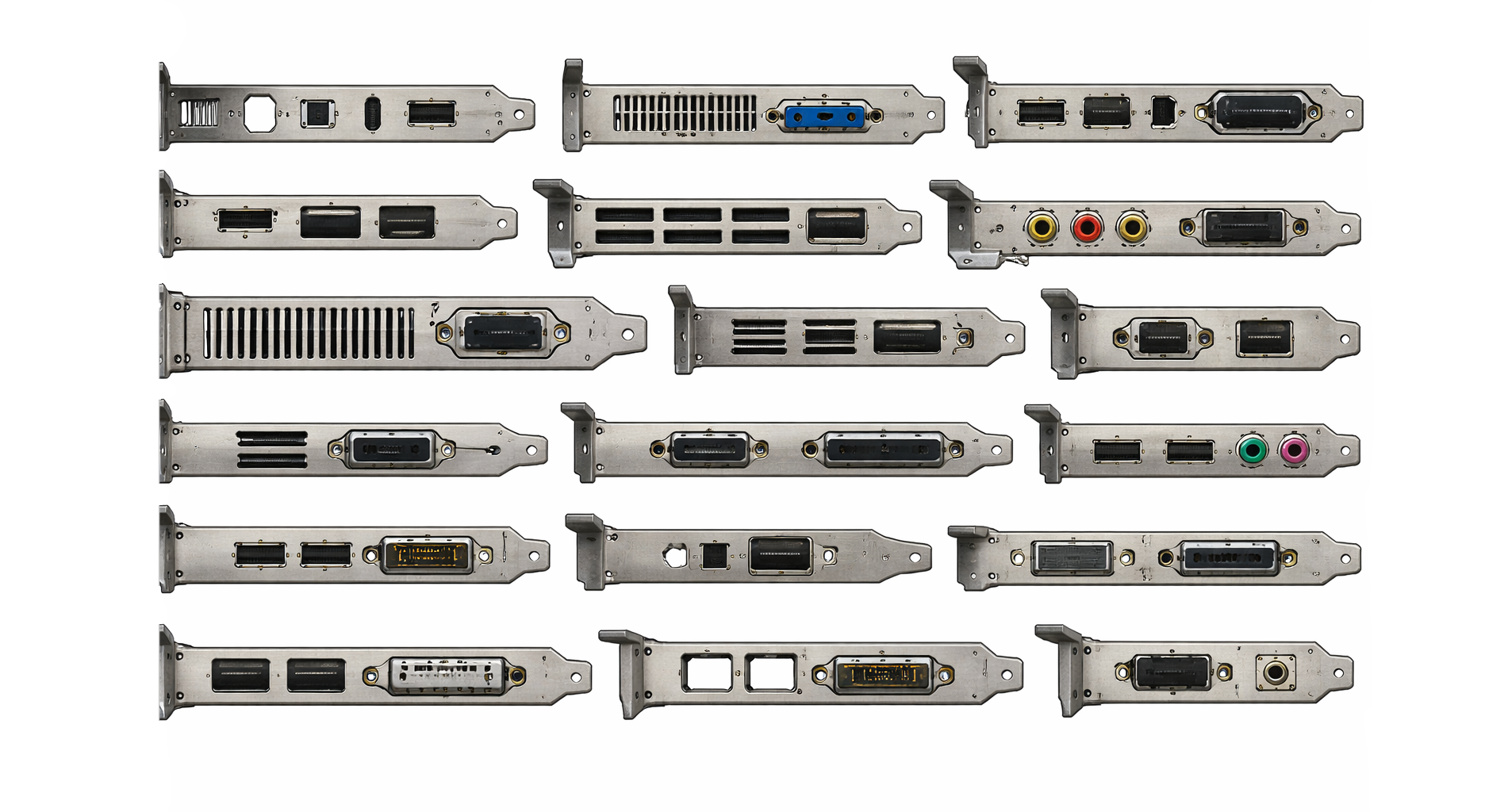
Any connector, any shape. D-Sub, USB, HDMI, BNC, RJ45, SFP, vents, security slots, or a profile nobody has ever asked for before.
Tabs & tapped holes
Tapped tabs (4-40 is the common one), mounting slots, jackscrew holes, and clearance holes, placed where your assembly needs them.
Material & thickness
SPCC cold-rolled steel is the standard and the value play. Stainless and aluminum are available, and thickness is yours to specify.
Finish & marking
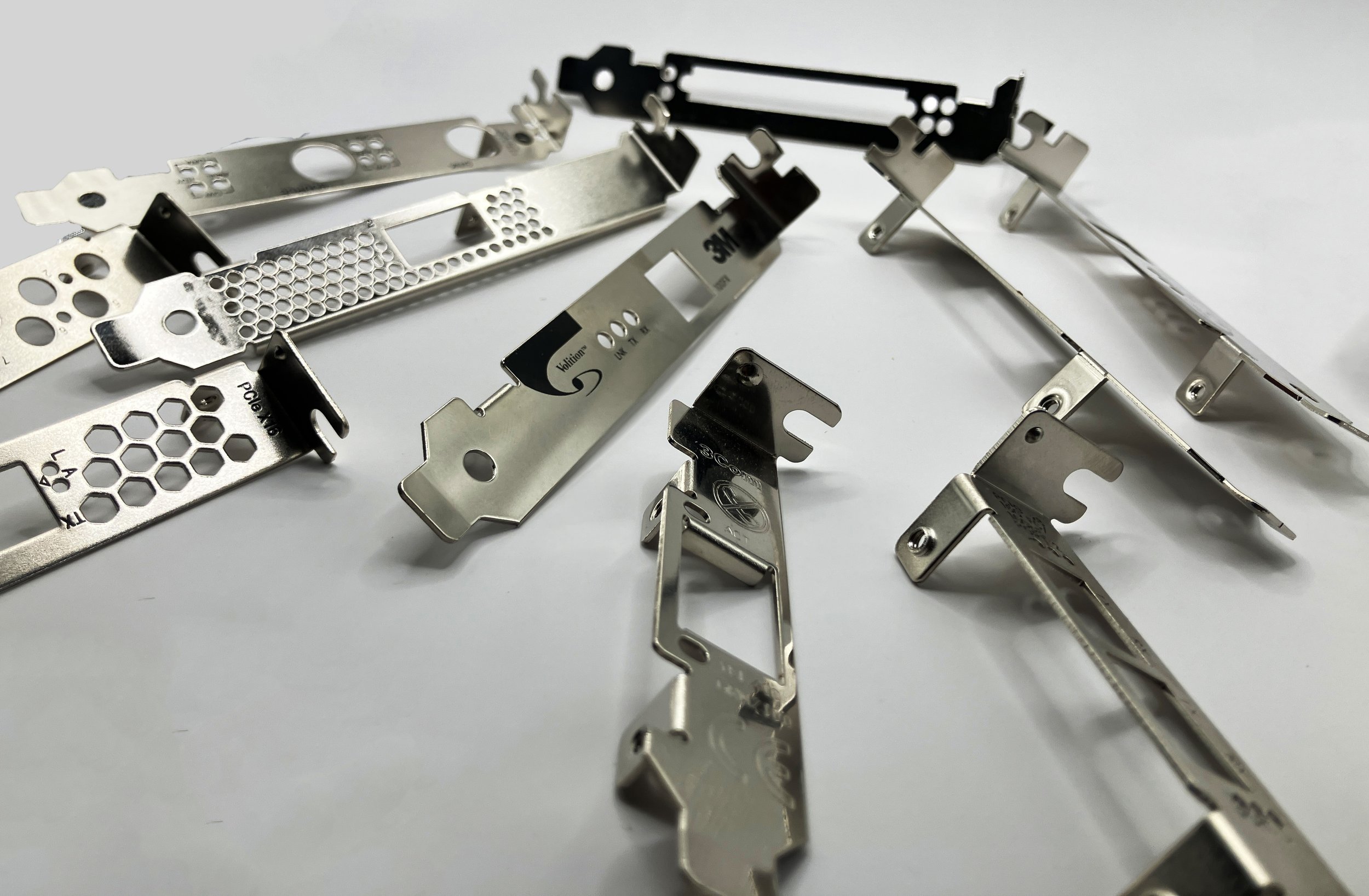
Nickel plating standard, with zinc, black oxide, bare, or powder coat on request. Add your logo or part number by silk screen or steel stamp.
/ / THE TOOLING DECISION
Start from our blank, or start from scratch.
Every custom part needs tooling, and the single biggest lever on that cost is whether your bracket's outline matches a blank we already have. Same part, $700 apart. Here's the honest breakdown so you can see which side you're on before you ever call us.
$1,055
Start from a HAPCO blank
Your bracket's overall profile matches one of our existing standard blanks (THG-6000, THG-6010, THG-2000, THG-6201, and others). We tool only your features: the cutouts, holes, bends, and tabs.
Lower tooling cost.
·
Proven geometry.
·
Still fully custom.
·
The blank already exists.
The profile is already in production.
Your cutouts, bends, and holes.
$1,755
Start from a custom blank
Your outline is genuinely its own thing: a height, width, or profile that doesn't match anything in our library. We tool the whole part from the blank up.
No compromises.
·
Yours alone.
·
Same per-piece pricing.
·
The part is exactly your geometry.
Kept on file, run only for your orders.
The difference is tooling only.
Not sure which one you are? Send the drawing. We'll tell you.
If a standard blank will carry your design, we'll say so, even though it's the cheaper option for you. After 15,000+ designs there's a good chance your outline already exists in our library. We'd rather save you $700 and earn the reorder than take it once and never hear from you again.
/ / WHAT DRIVES YOUR PRICE
Five choices that decide what a custom part costs.
Most of what you'll pay is set before we ever quote it, by decisions made on your drawing. Here's what actually moves the number, so you can design toward the price you want instead of finding out after the fact.
Your starting blank
The biggest single lever. A standard blank puts tooling at $1,055; a fully custom outline is $1,755.
Cutout count & shape
Every cutout is a feature in the die. Standard connector shapes are proven; unusual or organic profiles take more die work to get right.
The quiet one: tolerance
Bends & forming
Each bend is a forming operation. A flat bracket is the cheapest thing we make; every added bend, tight radius, or offset adds die complexity.
Material & thickness
SPCC cold-rolled steel is the value play. Stainless and aluminum cost more in material and tool wear, and thickness drives press tonnage.
Finish & marking
Nickel plating is standard. Specialty finishes, powder coat, silk screen, and steel stamping are add-ons, each priced separately and published.
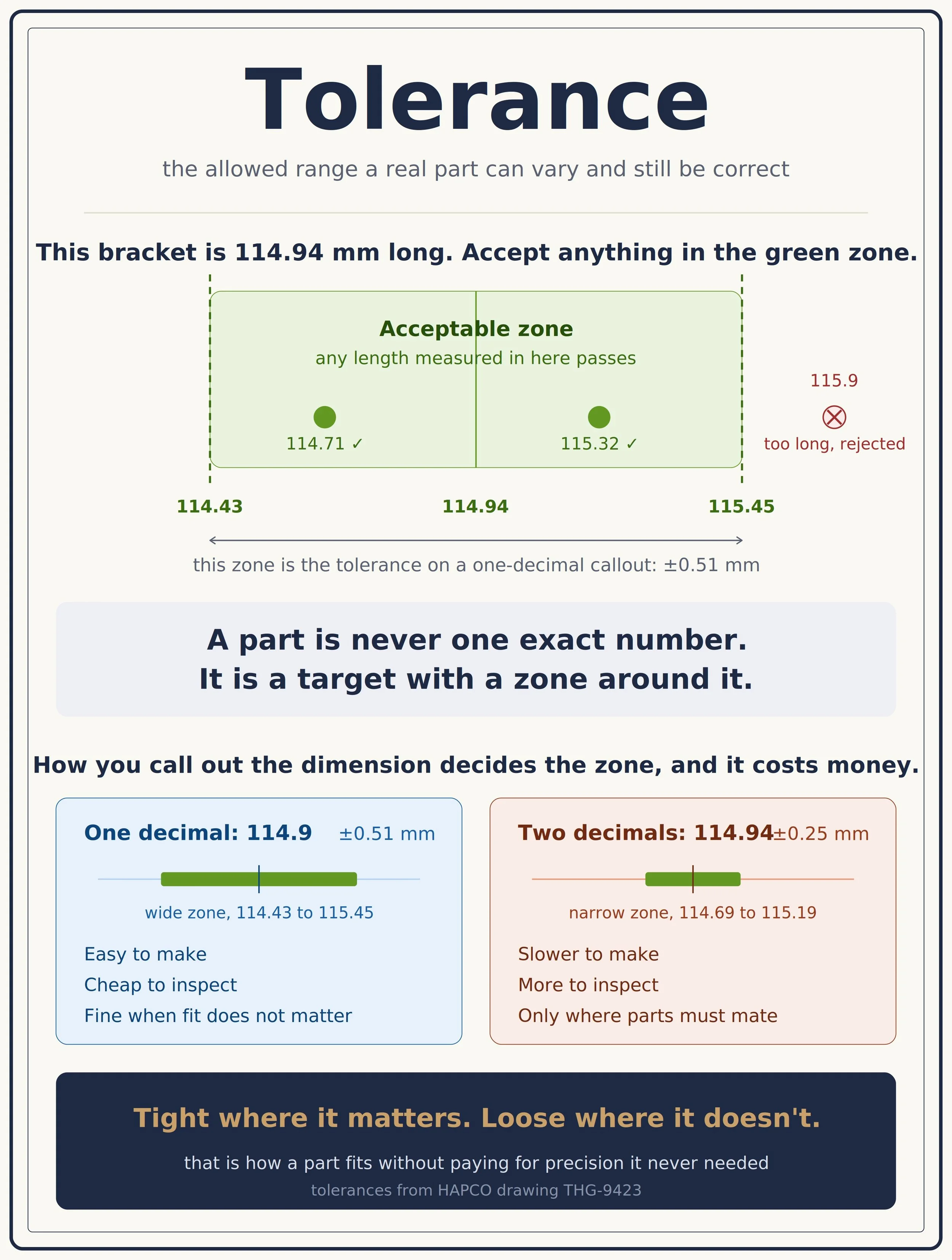
Every dimension on your drawing carries a tolerance, the allowable range that dimension can vary and still be correct. A hole called at 5.00 mm ±0.05 has to land between 4.95 and 5.05. On our side, that number sets how the die is built, how hard the part is held during forming, and how much of the run we stop to measure. A tight tolerance is a tighter die, slower forming, and inspection on features that would otherwise just get spot-checked.
Here's where it matters to your cost. Some dimensions are functional: the hole pattern that locates on a card, the cutout a connector passes through, the tab spacing that has to hit a chassis standoff. Those have to be tight or the part won't fit. Most dimensions aren't functional: overall blank width, a cosmetic edge, a clearance hole with millimeters to spare. Those can sit at standard tolerance and nothing about the part changes.
The common mistake is calling out one tight tolerance across the whole part, usually from a title-block default, which prices every feature as if it were critical. Tell us which dimensions actually have to hold, and we'll hold those and let the rest run standard. The part performs identically and costs less, with no design change and nothing given up. That's why it's the first thing our DFM review looks for.
Not sure which of your dimensions are the critical ones? Send the drawing and we'll walk through it with you. (480) 969-3797.
/ / HOW A CUSTOM PART HAPPENS
From your drawing to your dock.
Five steps, no surprises. The first article is the one that matters. Nothing runs in production until you've held a real part in your hand and signed off on it.
YOU
Send what you have
CAD, PDF, a dimensioned sketch, or a physical sample. You don't need a finished drawing to start the conversation.
2
48 HRS · US
Quote & DFM review
A written quote within one business day, plus a manufacturability review that flags anything driving cost or risk.
3
US
See the full workflow, start to finish, on the Process page →
Tooling
$1,055 from a standard blank, $1,755 fully custom. One time only. It's kept on file for every reorder after.
4
YOU APPROVE
First article
A real part, measured against your drawing, in your hands. Production doesn't start until you approve it.
5
US
Production & inspection
Your run is produced, inspected against your spec at our Mesa facility, then packaged and shipped to you.
1
/ / GETTING STARTED
What to send us. Anything is a start.
People can stall out here because they think they need a finished engineering drawing. They don't. Here's what helps most, in order, though the bottom tier is enough to get a real conversation going.
A CAD file
STEP, DWG, or DXF with your dimensions and tolerances called out. We can quote directly from it and go straight to tooling with no interpretation.
A PDF drawing or dimensioned sketch
A print, a marked-up screenshot, or a hand sketch with real numbers on it. We'll rebuild the geometry and confirm every dimension with you before cutting anything.
A sample or a photo with measurements
Mail us the part, or photograph it next to a ruler with your key dimensions noted. We reverse-engineer parts from samples routinely. It's a whole capability of ours.
Then tell us five things
These are the answers that turn a drawing into a real quote. If you don't know one yet, say so. A range works.
QTY
MATERIAL
FINISH
MOUNTS TO
TIMING
How many now, and roughly how many per year
Steel, stainless, aluminum, or "you tell us"
Nickel, zinc, black oxide, bare, powder coat
What chassis or card it has to fit into
When you need parts on your dock
/ / MATERIALS & FINISHES
What we'll make it out of.
Standard configurations cover the overwhelming majority of custom work. If your application needs something outside this list, ask. We'll tell you honestly whether we can produce it to your spec.
MATERIALS
SPCC cold-rolled steel
CRS
Stainless steel
Aluminum
The default for computer-hardware brackets. Forms cleanly, plates well, and it's the best value at volume.
Cold-rolled steel for general-purpose bracketry and stamped hardware.
Where corrosion resistance or a specific environment demands it. Higher material and tooling-wear cost.
Where weight matters more than cost. Available on request to your thickness spec.
FINISHES & MARKING
Nickel plating
Zinc · black oxide · bare
Powder coat
The default finish. Clean appearance, good conductivity for grounding, corrosion protection.
Alternate finishes to your spec. Tell us the environment and we'll tell you what makes sense.
Color and durable coverage where appearance is part of the product.
Silk screen · steel stamp
Your logo or part number, printed or permanently marked. Priced as published add-ons.
/ / WHAT IT COSTS
Custom doesn't mean "call for pricing."
Here's our actual published ladder for specialty and custom brackets, the same numbers we quote from. No sales call to see it. Your part may land slightly differently depending on the five drivers above, but this is the shape of it.
Above 2,500 pieces, or for an annual program, call and we'll quote it directly.
QUANTITY
100 pieces
250 pieces
500 pieces
750 pieces
1,000 pieces
2,500 pieces
Tooling — standard blank
Tooling — custom blank
Silk screen
Steel stamp
PER PIECE
$7.13
$4.20
$2.60
$1.89
$1.48
$1.06
$1,055 one-time
$1,755 one-time
$85 + $30 setup + $0.65/pc
$275 one-time
/ / WHAT GOES WRONG
Six ways a custom bracket goes sideways.
After 15,000+ designs, the failures repeat. Every one of these is preventable, and most get caught in the quote or the first article, which is exactly why both steps exist.
Wrong form factor
Full-height designed for a chassis that needs low-profile. The single most common mistake we see. We confirm form factor against your chassis at quote time, before tooling money is spent.
A cutout that doesn't match the real connector
Spec'd from a datasheet instead of the actual part in hand, and the connector won't seat. Send the connector or its real dimensions and the first article proves the fit before the run.
Paying for a custom blank you didn't need
$700 spent because nobody checked whether a standard blank would carry the design. We check every time, and we'll tell you when the cheaper path works.
Tolerance called out everywhere
A tight tolerance blanketed across the whole part inflates cost and buys nothing. Our DFM review flags it and asks which dimensions actually have to be held.
Skipping the first article
The difference between one wrong part and ten thousand wrong parts. We don't skip it — production doesn't start until you've approved a real piece.
A finish that doesn't match the environment
The right geometry with the wrong plating fails in the field, not on the bench. Tell us where the part lives and we'll flag a finish that won't survive it.
Where your custom parts are made
Custom brackets are produced by our long-standing manufacturing partner in China — a relationship in place since HAPCO was founded in 1994. Quoting, manufacturability review, inbound inspection, finishing, packaging, and fulfillment run through our Mesa, Arizona facility, and you buy from a US company on a USD invoice. Because the parts are of non-US origin, they don't meet Made-in-USA, Buy American, TAA, or ITAR requirements. if your program carries one of those, we're not your supplier and we'll say so directly. Full country-of-origin detail →
Matrox
Flextronics
COMPANIES THAT BUILD ON HAPCO BRACKETS
Cut Mark
AJA Video
Keystone
North Atlantic
/ / STRAIGHT TALK
When we're the right shop and when we're not.
Custom work goes badly when the fit was wrong from the start. Here's the honest read before you invest time in a drawing.
Send us the drawing if…
It's a stamped and formed sheet-metal bracket for commercial or industrial electronics
You need 100+ pieces with intent to reorder
You want a supplier who'll tell you how to make it cheaper, not just quote what you sent
You need the part to repeat identically for years, off tooling that stays on file
You want offshore pricing with US-based inspection and a US vendor of record
Look elsewhere if…
Your program requires Made in USA, Buy American, TAA, or domestic-content compliances
The part is ITAR-controlled or defense with country-of-origin restrictions
You need a handful of pieces, one time tooling won't pencil for you
You need custom parts next week a first article plus production is a 5–6 week reality
It isn't really sheet metal machined billet, castings, or molded plastic aren't what we do

X
X
X
X
X
X
/ / CUSTOM QUESTIONS
Custom bracket questions.
What engineers ask us most before sending a drawing.
-
No. A CAD file (STEP, DWG, DXF) is the fastest path, but a PDF print, a dimensioned sketch, or a physical sample is plenty to get a real quote. We reverse-engineer parts from samples and photos routinely. Send whatever you have and we'll tell you what else we need. The drawing can get finished together.
-
It's a one-time charge: about $1,055 if your part starts from one of our standard blanks, up to $1,755 for a fully custom blank. It is not recurring. Once built, your tooling is kept on file and used only for your orders, so every reorder skips tooling and setup entirely. That's why per-piece pricing gets better the longer a part lives with us.
-
Yes, and it's the most useful thing we do. Every custom quote comes with a manufacturability review. We work the design through with our manufacturing partners' engineers and come back with what's driving your cost: a tolerance that doesn't need to be tight, a bend that could be eliminated, or a standard blank that would save you $700 in tooling. We'd rather quote you a cheaper part and earn the reorder.
-
100 pieces. Because tooling is a one-time cost spread across your run, the economics improve steeply with volume. A custom bracket is about $7.13 each at 100 pieces and roughly $1.06 at 2,500. If you only need a handful of parts one time, we're honestly not the right fit and a machine shop will serve you better.
-
Standard production is 5–6 weeks from an approved PO, quoted as a firm date. That includes building tooling and producing a first article for your approval before the run. Reorders of the same part are faster, since the tooling already exists and there's no setup to repeat. For genuine deadlines we can expedite: ask, and where it's possible we'll fly parts in on an average of 7 to 10 business days.
-
Then it doesn't go to production that's the entire point of the step. We correct it and produce another first article for your approval. It's far cheaper to fix one part than to discover the problem in a 10,000-piece lot on your assembly line, which is why we don't let anyone skip it.
-
Two ways. Silk screening handles logos, part numbers, and color marking ($85 for the screen, $30 setup, $0.65 per part). Steel stamping gives a permanent mechanical mark for $275 one-time. We can also kit, label, and package to your spec before it ships.
-
By our long-standing manufacturing partner in China, a relationship that dates to HAPCO's founding in 1994. Quoting, manufacturability review, inbound quality inspection, finishing, packaging, and fulfillment all happen at our Mesa, Arizona facility. You order from a US company, pay a USD invoice on Net 30, and every shipment is inspected on our side before it reaches you. The Process and For Procurement pages cover the full flow.
-
No, and we won't claim otherwise. Our parts are manufactured overseas and finished in the US, which does not qualify them as US-origin under Made-in-USA, Buy American, TAA, or ITAR rules. If your custom part is going into a program with a domestic-content or origin restriction, a domestic stamper is the right call and we'll tell you that directly rather than let you find out in an audit.
-
Yes. We have a standard mutual NDA we can send for your review before you share anything sensitive. Your drawings and your tooling stay tied to your account and are used only for your orders.
Send the drawing. We'll do the rest.
CAD file, PDF, sketch, or a photo of the part in your hand. Whatever you've got. You'll have a written quote, a tooling number, and a manufacturability review within 48 hours.
QUOTES IN 24 HOURS · QUOTES@HAPCOGROUP.COM · MON-FRI 8AM-5PM MST